<?xml version="1.0" encoding="utf-8"?>
<feed xmlns="http://www.w3.org/2005/Atom" xmlns:media="http://search.yahoo.com/mrss/">
    <title>OpsShield</title>
    <link href="https://www.opsshield.com/blog/feed.xml" rel="self" />
    <link href="https://www.opsshield.com/blog" />
    <updated>2026-10-23T22:26:17+05:30</updated>
    <author>
        <name>OpsShield Team</name>
    </author>
    <id>https://www.opsshield.com/blog</id>

    <entry>
        <title>Proactive response to recent PHP vulnerabilities: Actions taken in cPGuard and cPGuard X</title>
        <author>
            <name>Nibin V M</name>
        </author>
        <link href="https://www.opsshield.com/blog/proactive-response-to-recent-php-vulnerabilities-actions-taken-in-cpguard-and-cpguard-x/"/>
        <id>https://www.opsshield.com/blog/proactive-response-to-recent-php-vulnerabilities-actions-taken-in-cpguard-and-cpguard-x/</id>
        <media:content url="https://www.opsshield.com/blog/media/posts/51/Proactive_PHP_security_response.webp" medium="image" />
            <category term="Uncategorized"/>

        <updated>2026-10-23T22:26:16+05:30</updated>
            <summary type="html">
                <![CDATA[
                        <img src="https://www.opsshield.com/blog/media/posts/51/Proactive_PHP_security_response.webp" alt="" />
                    At OPSSHIELD, maintaining the highest security standard for our clients' servers is our top priority. Following the recent public disclosure of critical PHP vulnerabilities, our team immediately took comprehensive action across cPGuard and cPGuardX to protect hosted websites, isolate threat vectors, and update system components.
                ]]>
            </summary>
        <content type="html">
            <![CDATA[
                    <p><img src="https://www.opsshield.com/blog/media/posts/51/Proactive_PHP_security_response.webp" class="type:primaryImage" alt="" /></p>
                <p><br/>
</p>
<p>At <strong>OPSSHIELD</strong>, maintaining the highest security standard for our clients' servers is our top priority. Following the recent public disclosure of critical PHP vulnerabilities, our team immediately took comprehensive action across cPGuard and cPGuardX to protect hosted websites, isolate threat vectors, and update system components.</p>
<p>Here is a detailed breakdown of the mitigation steps, WAF protections, and updates applied across our ecosystem.</p>
<h2>1. Instant Virtual Patching via WAF Rules</h2>
<p>Immediately upon the public disclosure of the vulnerability details, our security team deployed specialized Web Application Firewall (WAF) rules to inspect incoming request payloads and block exploitation attempts targeting vulnerable PHP installations.</p>
<p>The following cPGuard WAF rules actively protect hosted websites against these attack vectors:</p>
<ul>
<li>501501</li>
<li>501502</li>
<li>501503</li>
<li>501504</li>
<li>400015</li>
</ul>
<p>These rules inspect incoming multipart payload structures and request headers in real time, automatically dropping malicious traffic before it reaches the target application or PHP parser.</p>
<h2>2. Hardening Internal cPGuard Runtime Environment</h2>
<p>To ensure our security stack remains completely secure and unaffected, we immediately applied runtime configuration patches to cPGuard's internal PHP environment as a proactive defense mechanism.</p>
<p>Following the initial configuration hardening, we upgraded cPGuard's internal PHP runtime to the latest actively supported version.</p>
<h2>3. Rapid Patching &amp; Backporting for cPGuardX</h2>
<p>For cPGuardX environments, our automated build pipeline and engineering teams moved rapidly to secure all PHP instances:</p>
<p>Swift Build &amp; Patch Deployment: All managed PHP binaries compiled by cPGuardX were patched within hours of the official code fixes being made public.</p>
<p>Legacy Branch Backporting: Recognizing that many legacy production environments rely on older PHP releases, we backported the security fixes directly to PHP 8.1 and PHP 7.4.</p>
<p>LiteSpeed Web Server (LSWS) PHP Fixes: We integrated and applied the official fixes across LSWS PHP builds and restarted all relevant instances.</p>
<p>server-wide—completing the entire patching process within 5 hours of the upstream release</p>
<h2>Recommended Action for Server Administrators</h2>
<p>While virtual patching through cPGuard WAF rules and cPGuardX updates provides robust perimeter security, upgrading target PHP binaries to official vendor-patched releases remains the ultimate resolution.</p>
<p>We strongly advise all server administrators and web hosts to:</p>
<p>Update system PHP packages across all hosted accounts to the latest patched releases provided by your OS distribution or control panel (cPanel, DirectAdmin, Plesk, etc.).</p>
<p>Restart relevant web server and PHP-FPM / LSAPI worker processes to ensure running instances load the updated libraries.</p>
<h2>Stay Protected</h2>
<p>If your server runs cPGuard, your WAF rules are automatically updated to block these threats. You can review all release notes and technical logs on our official changelog.</p>
<p>If you have questions or require assistance verifying your configuration, please reach out to our support team at support.opsshield.com.</p>


<br/>
            ]]>
        </content>
    </entry>
    <entry>
        <title>PHP2Shell Critical Vulnerabilities (CVE-2026-109618 &amp; CVE-2026-109619): Mitigation Steps and cPGuard WAF Protection</title>
        <author>
            <name>Nibin V M</name>
        </author>
        <link href="https://www.opsshield.com/blog/php2shell-critical-vulnerabilities-cve-2026-109618-cve-2026-109619-mitigation-steps-and-cpguard-waf-protection/"/>
        <id>https://www.opsshield.com/blog/php2shell-critical-vulnerabilities-cve-2026-109618-cve-2026-109619-mitigation-steps-and-cpguard-waf-protection/</id>
        <media:content url="https://www.opsshield.com/blog/media/posts/50/PHP2Shell-mitigation_secure_uploads.webp" medium="image" />
            <category term="Uncategorized"/>

        <updated>2026-10-21T17:18:56+05:30</updated>
            <summary type="html">
                <![CDATA[
                        <img src="https://www.opsshield.com/blog/media/posts/50/PHP2Shell-mitigation_secure_uploads.webp" alt="" />
                    Server administrators are strongly advised to disable PHP's session upload progress feature as an immediate mitigation measure and prepare to apply official PHP vendor patches. This configuration update should be pushed across all active PHP versions and execution handlers running on your web servers. The&hellip;
                ]]>
            </summary>
        <content type="html">
            <![CDATA[
                    <p><img src="https://www.opsshield.com/blog/media/posts/50/PHP2Shell-mitigation_secure_uploads.webp" class="type:primaryImage" alt="" /></p>
                <p><br/>
</p>
<h2>PHP2Shell Mitigation: Disable Session Upload Progress and Virtual Patching with cPGuard</h2>
<p>Server administrators are strongly advised to disable PHP's session upload progress feature as an immediate mitigation measure and prepare to apply official PHP vendor patches. This configuration update should be pushed across all active PHP versions and execution handlers running on your web servers.</p>
<h3>Understanding the Risk</h3>
<p>The PHP development team recently issued security advisories detailing critical vulnerabilities (CVSS v4.0 rated 9.2) tracked under CVE-2026-109618 and CVE-2026-109619, collectively referred to as PHP2Shell.</p>
<p>Independent security research indicates that PHP's session.upload_progress implementation serves as a primary vector for exploitation. While disabling this feature reduces the exposure surface associated with session-based file upload handlers, it should be treated as an immediate temporary mitigation alongside proactive Web Application Firewall (WAF) filtering.</p>
<h3>Step 1: Disable Session Upload Progress Across All PHP Versions</h3>
<p>To mitigate the attack surface at the runtime level, ensure that session.upload_progress.enabled is explicitly turned off in your primary php.ini directives.</p>
<p>Add or verify the following configuration line:</p>
<p>session.upload_progress.enabled = Off</p>
<p>Global Configuration: Apply session.upload_progress.enabled = Off in the master php.ini files for every installed PHP binary version.</p>
<p>Runtime Overrides: Inspect pool configurations (php-fpm.conf, www.conf, or custom per-user INI files) to ensure this value is not explicitly re-enabled.</p>
<p>Restart Services: Reload/restart PHP-FPM, LiteSpeed, or Apache services so running worker processes adopt the updated configuration immediately:</p>
<h4>Will File Uploads Still Function?</h4>
<p>Yes. Standard file uploads across CMS platforms (WordPress, Joomla, Magento, etc.) and custom applications will continue to operate normally. Disabling this setting only turns off PHP's built-in progress tracking mechanism. Applications relying specifically on PHP_SESSION_UPLOAD_PROGRESS to render real-time upload progress bars may lose that specific tracking UI.</p>
<h3>Step 2: Layered Defense with cPGuard WAF</h3>
<p>To provide an extra layer of perimeter defense, the cPGuard WAF engine includes rules tailored to inspect incoming multipart HTTP payload headers and block requests carrying malicious vectors before they hit the PHP parser.</p>
<p>Automatic Rule Updates: The new rule will reach all servers autotmatically and you can force the rule update by disabling-enabling WAF module. The latest rule set automatically analyzes incoming request bodies for suspicious upload-progress parameters.</p>
<p>Proactive LFD Monitoring: IP addresses attempting to exploit unpatched PHP endpoints will be flagged and automatically blocked by cPGuard's Login Failure Daemon (LFD).</p>
<h3>Step 3: Patch PHP Packages</h3>
<p>While runtime mitigation and WAF rules significantly reduce your risk, virtual patching is not a permanent replacement for vendor security updates.</p>
<p>Monitor your OS package manager repositories (CloudLinux, AlmaLinux, RHEL, Ubuntu, or Debian) for patched PHP packages.</p>
<p>Upgrade all PHP instances as soon as official vendor updates are published.</p>
<h4>Useful Links &amp; References</h4>
<p>Official PHP Release Announcement: <a href="https://www.php.net/archive/2026.php">https://www.php.net/archive/2026.php</a></p>
<p>External reference: <a href="https://blog.flatt.tech/entry/php2shell">https://blog.flatt.tech/entry/php2shell</a></p>
<p>External reference: <a href="https://www.huntress.com/blog/php2shell-leaked-critical-php-vulnerabilities">https://www.huntress.com/blog/php2shell-leaked-critical-php-vulnerabilities</a></p>


<br/>
            ]]>
        </content>
    </entry>
    <entry>
        <title>cPGuard v5.88: Smarter AI Bot Protection, Enhanced LFD &amp; Improved CAPTCHA Handling</title>
        <author>
            <name>Boni lal CP</name>
        </author>
        <link href="https://www.opsshield.com/blog/cpguard-v5-88-smarter-ai-bot-protection-enhanced-lfd-improved-captcha-handling/"/>
        <id>https://www.opsshield.com/blog/cpguard-v5-88-smarter-ai-bot-protection-enhanced-lfd-improved-captcha-handling/</id>
        <media:content url="https://www.opsshield.com/blog/media/posts/49/cPGuard_5.88_version_release.webp" medium="image" />
            <category term="CPGUARD"/>

        <updated>2026-10-15T21:05:03+05:30</updated>
            <summary type="html">
                <![CDATA[
                        <img src="https://www.opsshield.com/blog/media/posts/49/cPGuard_5.88_version_release.webp" alt="" />
                    Announcing cPGuard v5.88: Advanced Fake AI Bot Mitigation and LFD Enhancements We are excited to announce the release of cPGuard version 5.88, featuring major updates to our Login Failure Daemon (LFD) system designed to protect servers against emerging security threats and optimise resource management. Recent&hellip;
                ]]>
            </summary>
        <content type="html">
            <![CDATA[
                    <p><img src="https://www.opsshield.com/blog/media/posts/49/cPGuard_5.88_version_release.webp" class="type:primaryImage" alt="" /></p>
                
<h2>Announcing cPGuard v5.88: Advanced Fake AI Bot Mitigation and LFD Enhancements</h2>
<p>We are excited to announce the release of cPGuard version 5.88, featuring major updates to our Login Failure Daemon (LFD) system designed to protect servers against emerging security threats and optimise resource management.</p>
<h2>The Growing Challenge: Fake AI Bots and Vulnerability Scanners</h2>
<p>Recent security research highlights a significant rise in malicious traffic masquerading as legitimate AI crawlers. In a real-world analysis conducted on a server hosting over 1,000 accounts, 173,296 requests identified themselves using known AI User-Agents, including:</p>
<ul>
<li>GPTBot</li>
<li>ChatGPT-User</li>
<li>OAI-SearchBot</li>
<li>ClaudeBot</li>
<li>Claude-User</li>
<li>SearchBot</li>
<li>PerplexityBot</li>
</ul>
<p>Crucially, nearly 90% of this traffic originates from a localised set of IP addresses constantly rotating User-Agents randomly.</p>
<p>Detecting and neutralising these fake agents is essential—not only to preserve critical server resources, but also to ensure legitimate AI crawlers can index content without degrading website performance.</p>
<h2>What's New in Version 5.88</h2>
<h3>1. Smart User-Agent Analytics &amp; Fake Bot Mitigation</h3>
<p>We have integrated a dedicated analytics module into LFD that inspects User-Agent behaviour to identify and automatically block fake AI bots and vulnerability scanners in real time. Production server testing has demonstrated exceptional results, instantly identifying and neutralising a large volume of IPs delivering spoofed traffic.</p>
<figure><figure class="post__image"><img loading="lazy" alt="" src="https://www.opsshield.com/blog/media/posts/49/smart-user-analytics-and-fake-bots.webp"  sizes="(max-width: 48em) 100vw, 768px" srcset="https://www.opsshield.com/blog/media/posts/49/responsive/smart-user-analytics-and-fake-bots-xs.webp 300w ,https://www.opsshield.com/blog/media/posts/49/responsive/smart-user-analytics-and-fake-bots-sm.webp 480w ,https://www.opsshield.com/blog/media/posts/49/responsive/smart-user-analytics-and-fake-bots-md.webp 768w ,https://www.opsshield.com/blog/media/posts/49/responsive/smart-user-analytics-and-fake-bots-lg.webp 1024w ,https://www.opsshield.com/blog/media/posts/49/responsive/smart-user-analytics-and-fake-bots-xl.webp 1360w ,https://www.opsshield.com/blog/media/posts/49/responsive/smart-user-analytics-and-fake-bots-2xl.webp 1600w"></figure></figure>
<h3>2. AI Crawling Analytics &amp; Rate Limiting Preparation</h3>
<p>In addition to blocking spoofed traffic, cPGuard now tracks and aggregates authentic AI bot hits across websites. This data will lay the foundation for an upcoming module designed to give server administrators fine-grained rate-limiting controls over AI crawlers.</p>
<h3>3. Automatic CAPTCHA-Verified IP Detection</h3>
<p>To resolve CAPTCHA loop issues caused by local or provider DNS caching, LFD now automatically identifies IPs that have successfully completed a WAF CAPTCHA verification. Once verified, these IPs are bypassed from redundant CAPTCHA challenges, ensuring a smooth experience for legitimate users.</p>
<h3>4. System Improvements &amp; Bug Fixes</h3>
<p>Version 5.88 also includes various performance tweaks and bug fixes to enhance system stability across all supported platforms.</p>


<p>To review the complete list of changes and technical updates, visit our <a href="https://opsshield.com/changelog/">official changelog</a>.</p>
<p>The update is now available and will be applied automatically on servers. Thank you for choosing cPGuard to keep your servers safe and secure!</p>
            ]]>
        </content>
    </entry>
    <entry>
        <title>More Options, Greater Value: Introducing Flexible cPGuard Pricing &amp; Plans Built for Every Scale</title>
        <author>
            <name>Nibin V M</name>
        </author>
        <link href="https://www.opsshield.com/blog/more-options-greater-value-introducing-flexible-cpguard-pricing-plans-built-for-every-scale/"/>
        <id>https://www.opsshield.com/blog/more-options-greater-value-introducing-flexible-cpguard-pricing-plans-built-for-every-scale/</id>
        <media:content url="https://www.opsshield.com/blog/media/posts/48/cpguard_flexible_plans_pricing.webp" medium="image" />
            <category term="Uncategorized"/>

        <updated>2026-09-04T15:26:06+05:30</updated>
            <summary type="html">
                <![CDATA[
                        <img src="https://www.opsshield.com/blog/media/posts/48/cpguard_flexible_plans_pricing.webp" alt="" />
                    At OPSSHIELD, our goal has always been to provide enterprise-grade web security that is both robust and accessible. As hosting environments evolve, server administrators need flexibility—paying only for what they actually use without sacrificing security features. To better support every stage of your growth, we&hellip;
                ]]>
            </summary>
        <content type="html">
            <![CDATA[
                    <p><img src="https://www.opsshield.com/blog/media/posts/48/cpguard_flexible_plans_pricing.webp" class="type:primaryImage" alt="" /></p>
                <p><br/>
</p>
<h1>More Options, Greater Value: Introducing Flexible cPGuard Pricing &amp; Plans Built for Every Scale</h1>
<p>At OPSSHIELD, our goal has always been to provide enterprise-grade web security that is both robust and accessible. As hosting environments evolve, server administrators need flexibility—paying only for what they actually use without sacrificing security features.</p>
<p>To better support every stage of your growth, we are introducing an updated plan structure with <strong>lower entry pricing and more options for right-sizing licenses as your hosting environment grows.</strong></p>
<blockquote>
<p><strong>Important Notes for Our Clients:</strong></p>
<ul>
<li><strong>Effective Date:</strong> The new plan structure will go into effect on <strong>September 16, 2026</strong>.</li>
<li><strong>Existing Customers:</strong> <strong>All active subscriptions remain 100% untouched.</strong><br/>Your current pricing and plan limits are fully grandfathered for your existing active services. They will retain their current pricing and license limits for as long as those subscriptions remain active.</li>
</ul>
</blockquote>
<h3><strong>What's New?</strong></h3>
<p>We listened to your feedback. Many smaller hosting providers and admins needed an entry-level tier for lightweight VPS setups, while growing hosts wanted a dedicated step between mid-tier and unlimited limits.</p>
<p>To give you greater control over your security budget, we are introducing <strong>two brand-new plan tiers</strong> alongside our restructured options for new licenses:</p>
<table>
<thead>
<tr>
<th>Plan Level</th>
<th>User Limit</th>
<th>Monthly Subscription</th>
<th>Annual Subscription (Billed Yearly)</th>
</tr>
</thead>
<tbody>
<tr>
<td><strong>Starter</strong> <em>(New!)</em></td>
<td>Up to 10 Users</td>
<td><strong>$3.50</strong> / month</td>
<td><strong>$36/year</strong> ($3/month)</td>
</tr>
<tr>
<td><strong>Growth</strong></td>
<td>Up to 50 Users</td>
<td><strong>$7.00</strong> / month</td>
<td><strong>$72/year</strong> ($6/month)</td>
</tr>
<tr>
<td><strong>Business</strong> <em>(New!)</em></td>
<td>Up to 250 Users</td>
<td><strong>$11.00</strong> / month</td>
<td><strong>$108/year</strong> ($9/month)</td>
</tr>
<tr>
<td><strong>Pro</strong></td>
<td>Unlimited Users</td>
<td><strong>$14.00</strong> / month</td>
<td><strong>$132/year</strong> ($11/month)</td>
</tr>
</tbody>
</table>

<h3><strong>Why This Delivers More Value</strong><strong></strong></h3>
<ul>
<li><strong>Unlocks Access at Just $3/Month:</strong> Running smaller VPS instances? You no longer have to pay for capacity you don't need. The new <strong>10-User Starter Plan</strong> lowers the entry point to just <strong>$3/month with annual billing</strong>.</li>
<li><strong>Granular Scaling:</strong> Previously, crossing the 50-user threshold meant jumping directly to the Unlimited plan. The new <strong>250-User Business Plan</strong> bridges that gap, giving growing hosting providers a more cost-effective option before they need an Unlimited license.</li>
<li><strong>Legacy Rates Available with Annual Billing:</strong> For the 50-User and Unlimited plans, annual billing retains the same effective monthly rates as our previous pricing—<strong>$6/month for 50 Users and $11/month for Unlimited</strong>. This gives new licenses the option to maintain those established rates with an annual commitment.</li>
</ul>
<h3><strong>Right-Sizing Security for Your Fleet</strong></h3>
<p>With more plan options and lower entry pricing, <strong>new deployments can choose the license that best matches the size of their server and scale as they grow</strong>.</p>
<p>Importantly, there are no feature compromises between tiers. <strong>Every cPGuard plan includes the same core security features, updates, and support—the only difference is the number of server users covered.</strong></p>
<h3><strong>Built to Grow, Priced to Stay Accessible</strong></h3>
<p>Since its launch, cPGuard has continuously evolved alongside the needs of web hosting providers and server administrators. What began as a focused server security solution has grown into a <strong>comprehensive security suite</strong>, with advanced malware detection and automated cleanup, WAF integration, intelligent firewall protection, and continued developments such as our native <strong>LFD integration</strong>.</p>
<p>As cPGuard has expanded, our core philosophy has remained the same: <strong>powerful server security should remain accessible and cost-effective at every scale</strong>. Rather than simply increasing prices as the platform grows, our new plan structure gives customers more choice—allowing smaller deployments to start at a lower cost while providing clear, affordable steps as their infrastructure grows.</p>
<p><strong>Whether you're securing a small VPS or hundreds of hosting servers, you get the same cPGuard security features, updates, and support—the plan you choose simply reflects the size of the server you're protecting.</strong></p>
<p>For all existing active subscriptions, <strong>your current pricing and plan limits remain unchanged.</strong></p>


<br/>
            ]]>
        </content>
    </entry>
    <entry>
        <title>Moving Beyond Fail2ban with cPGuard&#x27;s Native LFD</title>
        <author>
            <name>Nibin V M</name>
        </author>
        <link href="https://www.opsshield.com/blog/moving-beyond-fail2ban-with-cpguards-native-lfd/"/>
        <id>https://www.opsshield.com/blog/moving-beyond-fail2ban-with-cpguards-native-lfd/</id>
        <media:content url="https://www.opsshield.com/blog/media/posts/47/cpguard-new-bruteforce-lfd.png" medium="image" />
            <category term="Uncategorized"/>

        <updated>2026-05-26T00:33:11+05:30</updated>
            <summary type="html">
                <![CDATA[
                        <img src="https://www.opsshield.com/blog/media/posts/47/cpguard-new-bruteforce-lfd.png" alt="" />
                    Next-Gen Brute-Force Protection: Why You Should Switch from Fail2ban to cPGuard LFD Securing your servers against relentless brute-force and web-based attacks requires agility, speed, and deep integration. For years, Fail2ban has been the standard tool for monitoring logs and banning malicious IPs in cPGuard. However,&hellip;
                ]]>
            </summary>
        <content type="html">
            <![CDATA[
                    <p><img src="https://www.opsshield.com/blog/media/posts/47/cpguard-new-bruteforce-lfd.png" class="type:primaryImage" alt="" /></p>
                
<h1>Next-Gen Brute-Force Protection: Why You Should Switch from Fail2ban to cPGuard LFD</h1>
<p>Securing your servers against relentless brute-force and web-based attacks requires agility, speed, and deep integration. For years, Fail2ban has been the standard tool for monitoring logs and banning malicious IPs in cPGuard. However, as modern attack vectors evolve, standard tools can sometimes struggle under heavy load, consuming precious CPU and memory.</p>
<p>To solve this, we are thrilled to introduce CPG LFD—our brand-new, ultra-lightweight Login Failure Daemon designed specifically for cPGuard.</p>
<p>If you are currently running Fail2ban, here is why switching to cpglfd is the single best upgrade you can make for your server's performance and security today.</p>
<h2>What is cPGuard LFD ( cpglfd)?</h2>
<p>cPGuard LFD is a proprietary, high-performance log-parsing and login-failure daemon built from the ground up to replace Fail2ban within the cPGuard ecosystem. It monitors system and application logs in real-time, detects malicious authentication attempts, and instantly mitigates brute-force attacks before they can overwhelm your applications, websites or control panels.</p>
<figure><figure class="post__image"><img loading="lazy" alt="" src="https://www.opsshield.com/blog/media/posts/47/cpguard-lfd-working.webp"  sizes="(max-width: 48em) 100vw, 768px" srcset="https://www.opsshield.com/blog/media/posts/47/responsive/cpguard-lfd-working-xs.webp 300w ,https://www.opsshield.com/blog/media/posts/47/responsive/cpguard-lfd-working-sm.webp 480w ,https://www.opsshield.com/blog/media/posts/47/responsive/cpguard-lfd-working-md.webp 768w ,https://www.opsshield.com/blog/media/posts/47/responsive/cpguard-lfd-working-lg.webp 1024w ,https://www.opsshield.com/blog/media/posts/47/responsive/cpguard-lfd-working-xl.webp 1360w ,https://www.opsshield.com/blog/media/posts/47/responsive/cpguard-lfd-working-2xl.webp 1600w"></figure></figure>
<h2></h2>
<h2>Why cpglfd eclipses traditional Fail2ban</h2>
<p>While Fail2ban is a versatile tool, it is built as a generic solution. cpglfd, on the other hand, is purpose-built for web hosting environments running cPGuard.</p>
<h3>1. Ultra-Lightweight &amp; High Efficiency</h3>
<p>Fail2ban can become resource-heavy, especially on busy servers with massive log files. It frequently spikes CPU usage when parsing logs under a heavy distributed brute-force attack. cpglfd has been engineered for maximum efficiency, boasting a microscopic resource footprint. It processes logs with minimal overhead, leaving your RAM and CPU free to serve your actual website traffic.</p>
<h3>2. Native cPGuard firewall integration</h3>
<p>Fail2ban relies on generic external wrappers to manipulate system firewalls, which can occasionally cause synchronization delays. The cpglfd features native, deep integration with the cPGuard firewall layer. When an IP is flagged for abuse, the block is injected directly and seamlessly into your cPGuard firewall rules instantly, ensuring zero-lag mitigation. When you enable Captcha protection in the firewall settings, the cpglfd block enabled Captcha verification for the blocked IPs and let the genuine users to unblock themselves.</p>
<h3>3. Smarter web &amp; Brute-Force defense</h3>
<p>Because it is deeply embedded into our ecosystem, cpglfd possesses a contextual understanding of web attacks that generic tools lack. It works hand-in-hand with cPGuard's existing threat intelligence, allowing it to differentiate between a genuinely malicious botnet and an accidental user typo much more effectively.</p>
<h3>4. No need for third-party dependencies</h3>
<p>Since cpglfd is developed inhouse, it does not need to install third-party packages and maintaining them.</p>
<h2>The Verdict: cpglfd is the new recommended standard</h2>
<p>To ensure our customers get the absolute best performance out of their infrastructure, cPGuard now officially recommends cpglfd over Fail2ban for all deployments.</p>
<p>By making the switch, you immediately unlock:</p>
<ul>
<li>Better server response times under attack.</li>
<li>Drastically reduced CPU and memory overhead.</li>
<li>Tighter, unified security orchestration.</li>
</ul>
<h3>How to Switch</h3>
<p>Transitioning from Fail2ban to the new LFD module is completely seamless. We have automated the process to ensure your server remains fully protected during the swap.</p>
<p>You can enable the new cpglfd module directly through your cPGuard's Firewall settings page</p>
<p>Select server &gt; Go to Firewall settings &gt;  Turn on Intrusion Defence (lfd)</p>
<p>Fail2ban will be automatically turned off when lfd is turned ON</p>
<p>and using CLI, you can run the following command</p>
<pre class="language-bash"><code> cpgcli lfd --enable</code></pre>
            ]]>
        </content>
    </entry>
    <entry>
        <title>cPGuard Firewall: Enhanced Performance with iptables &amp; new features</title>
        <author>
            <name>Nibin V M</name>
        </author>
        <link href="https://www.opsshield.com/blog/cpguard-firewall-enhanced-performance-with-iptables-new-features/"/>
        <id>https://www.opsshield.com/blog/cpguard-firewall-enhanced-performance-with-iptables-new-features/</id>
        <media:content url="https://www.opsshield.com/blog/media/posts/46/cpguard-firewall-iptables-nftables.webp" medium="image" />
            <category term="Uncategorized"/>

        <updated>2026-04-28T13:18:42+05:30</updated>
            <summary type="html">
                <![CDATA[
                        <img src="https://www.opsshield.com/blog/media/posts/46/cpguard-firewall-iptables-nftables.webp" alt="cPGuard Firewall iptables &amp; nftables" />
                    Announcing cPGuard Firewall 5.83.00: Enhanced Performance with iptables &amp; New Features We are excited to announce a major update to the cPGuard system firewall. Since our initial NFT-based launch in late 2025, we have been listening closely to your feedback and monitoring performance across diverse&hellip;
                ]]>
            </summary>
        <content type="html">
            <![CDATA[
                    <p><img src="https://www.opsshield.com/blog/media/posts/46/cpguard-firewall-iptables-nftables.webp" class="type:primaryImage" alt="cPGuard Firewall iptables &amp; nftables" /></p>
                
<h2>Announcing cPGuard Firewall 5.83.00: Enhanced Performance with iptables &amp; New Features</h2>
<p>We are excited to announce a major update to the cPGuard system firewall. Since our initial NFT-based launch in late 2025, we have been listening closely to your feedback and monitoring performance across diverse environments.<br/>In version 5.83.00, we are introducing a revamped firewall architecture designed for stability, speed, and better user control.</p>
<h3>The Shift: Returning to iptables/ipset</h3>
<p>When we first introduced the NFT-based firewall, the goal was to leverage modern netfilter tools for a lighter, faster experience. However, real-world deployments presented unexpected challenges, including:</p>
<ul>
<li>Stalled firewall rules and slow rule checks.</li>
<li>Unexpected rule failures.</li>
<li>Performance bottlenecks under heavy loads.</li>
</ul>
<p>After extensive internal testing and consultation with our customers, we have decided to revamp the system using iptables/ipset as the primary provider. This ensures the reliability you expect from cPGuard, while still keeping nftables available as an option for those who prefer it.</p>
<h3>What’s New in Version 5.83.00?</h3>
<p>The latest version is more than just a provider shift; it includes several functional enhancements:</p>
<ul>
<li><strong>Optimized Performance:</strong> The iptables-based system is significantly faster and maintains a low system load, even when managing tens of thousands of IP addresses.</li>
<li><strong>Advanced DoS Mitigation:</strong> New rules allow you to set connection limits per port/IP. The updated logic also resolves excessive logging issues during active attacks.</li>
<li><strong>IP &amp; Country Ignore Lists:</strong> Entries in the ignore list will now bypass deny rules and the IPDB, ensuring your trusted connections are never interrupted.</li>
<li><strong>Flexible Providers:</strong> While iptables is now the default for new installations, you can switch between iptables and nftables at any time via the UI or CLI.</li>
</ul>
<h3>Introducing the New Grey List &amp; Captcha Unlock</h3>
<p>To reduce support tickets and improve the end-user experience, we’ve introduced a 24-hour Grey List.<br/>If an IP is temporarily blocked, users can now use a Captcha-based unlock option to delist themselves (similar to CSF messenger).</p>
<figure><figure class="post__image"><img loading="lazy" alt="" src="https://www.opsshield.com/blog/media/posts/46/cpguard-firewall-captcha.webp"  sizes="(max-width: 48em) 100vw, 768px" srcset="https://www.opsshield.com/blog/media/posts/46/responsive/cpguard-firewall-captcha-xs.webp 300w ,https://www.opsshield.com/blog/media/posts/46/responsive/cpguard-firewall-captcha-sm.webp 480w ,https://www.opsshield.com/blog/media/posts/46/responsive/cpguard-firewall-captcha-md.webp 768w ,https://www.opsshield.com/blog/media/posts/46/responsive/cpguard-firewall-captcha-lg.webp 1024w ,https://www.opsshield.com/blog/media/posts/46/responsive/cpguard-firewall-captcha-xl.webp 1360w ,https://www.opsshield.com/blog/media/posts/46/responsive/cpguard-firewall-captcha-2xl.webp 1600w"></figure></figure>
<p>Note: Currently available for cPanel and DirectAdmin, with support for more panels coming soon.</p>
<h3>How to Switch to the iptables Firewall</h3>
<p>To ensure stability, we are not enforcing the new iptables ruleset on existing installations automatically. If you wish to migrate your current server to the new firewall, you can do so via:</p>
<p><strong>1. Command Line Interface</strong> (CLI): Run the following command:</p>
<pre class="language-bash"><code>cpgcli fw --provider iptables</code></pre>
<p><strong>2. App Portal</strong>: Navigate to Protection &gt; Firewall and update your settings.</p>
<h3>Looking Ahead: The New LFD Module</h3>
<p>Our work doesn't stop here. We are currently developing a new LFD (Log Failure Daemon) module to replace the existing Fail2ban-based monitoring. This new system will be:</p>
<ul>
<li><strong>Lighter and Faster:</strong> Built specifically for the cPGuard ecosystem.</li>
<li><strong>Tightly Integrated:</strong> Allowing the Grey List to be fully utilized so genuine clients can easily unlock themselves after a block.</li>
</ul>
<p>Stay tuned for these upcoming changes as we continue to evolve cPGuard to meet your security needs!</p>

            ]]>
        </content>
    </entry>
    <entry>
        <title>cPGuard Elevates Webuzo Security with New User-Level Plugin Integration</title>
        <author>
            <name>Nibin V M</name>
        </author>
        <link href="https://www.opsshield.com/blog/cpguard-elevates-webuzo-security-with-new-user-level-plugin-integration/"/>
        <id>https://www.opsshield.com/blog/cpguard-elevates-webuzo-security-with-new-user-level-plugin-integration/</id>
        <media:content url="https://www.opsshield.com/blog/media/posts/45/webuzo_user_level_plugin.webp" medium="image" />
            <category term="Uncategorized"/>

        <updated>2025-12-26T22:39:40+05:30</updated>
            <summary type="html">
                <![CDATA[
                        <img src="https://www.opsshield.com/blog/media/posts/45/webuzo_user_level_plugin.webp" alt="" />
                    We are thrilled to announce a significant enhancement to the cPGuard ecosystem: the immediate availability of a user-level plugin for the Webuzo control panel. In our latest release, we have bridged the gap between server-side security and end-user control. This elevated integration empowers hosting providers&hellip;
                ]]>
            </summary>
        <content type="html">
            <![CDATA[
                    <p><img src="https://www.opsshield.com/blog/media/posts/45/webuzo_user_level_plugin.webp" class="type:primaryImage" alt="" /></p>
                
<p>We are thrilled to announce a significant enhancement to the cPGuard ecosystem: the immediate availability of a user-level plugin for the Webuzo control panel.</p>
<p>In our latest release, we have bridged the gap between server-side security and end-user control. This elevated integration empowers hosting providers using Webuzo to offer premium, self-service security tools directly to their customers, fostering a safer and more transparent hosting environment.</p>
<h3>Empowering the End-User</h3>
<p>Security is no longer just the administrator's responsibility; it is a collaborative effort. With this new integration, Webuzo users gain full visibility into their account's security status.</p>
<h4>Key capabilities now available to end-users include:</h4>
<p><strong>Detailed Malware Visibility</strong>: Users can view specific malware files detected within their account.</p>
<p><strong>On-Demand Scanning</strong>: Users can initiate manual file scans instantly, ensuring peace of mind after site updates or uploads.</p>
<p><strong>Real-Time Analytics</strong>: Access to comprehensive statistics regarding web attacks targeting their specific websites.</p>
<p>We believe this deeper integration is a game-changer for hosting providers. It allows you to deliver premium security tools that build trust with every client while reducing the support volume related to security queries.</p>
<h3>A Quick Preface: What is cPGuard?</h3>
<p>For those new to our platform, cPGuard is an all-in-one automated security suite specifically engineered for Linux web hosting servers. It acts as far more than a simple firewall; it provides a multi-layered defense system designed to catch threats that traditional antivirus software often misses.</p>
<h3>Our architecture is built on robust pillars of protection:</h3>
<p><strong>Smart Malware Scanner</strong>: Detects and remediates threats automatically.</p>
<p><strong>Web Application Firewall (WAF)</strong>: Blocks exploits before they reach applications.</p>
<p><strong>Proactive Attack Blocking (IPDB)</strong>: A distributed firewall module that leverages global threat intelligence.</p>
<p><strong>CMS Toolkit</strong>: Features auto-patching to secure WordPress and other CMS installations proactively.</p>
<h3>Why cPGuard is the Strategic Choice</h3>
<p>Choosing cPGuard is a strategic decision for server administrators who demand high-level security without the "performance tax" often associated with heavy security suites.</p>
<h3>Here is why cPGuard stands out:</h3>
<p><strong>Superior Resource Efficiency</strong>: Designed to be lightweight, ensuring your server resources are dedicated to serving websites, not running security scans.</p>
<p><strong>Surgical Malware Cleanup</strong>: Our intelligent engine cleans malicious injections from core files rather than simply deleting the file, keeping sites online and functional.</p>
<p><strong>Collective IP Intelligence (IPDB)</strong>: Our distributed firewall module instantly blocks abusive IPs detected anywhere in our global network.</p>
<p><strong>Reduced Management Overhead</strong>: Automated tools and a unified dashboard make managing security across multiple servers effortless.</p>
<h3>Get Started</h3>
<p>Ready to upgrade your Webuzo server's security posture? The new integration is available now.</p>
<p><a href="https://opsshield.com/help/cpguard/webuzo-security-using-cpguard-webuzo-antivirus-webuzo-antimalware/">Click here for the Installation Guide and Documentation</a></p>

            ]]>
        </content>
    </entry>
    <entry>
        <title>CSF Retired – Meet the new cPGuard Firewall</title>
        <author>
            <name>Nibin V M</name>
        </author>
        <link href="https://www.opsshield.com/blog/csf-retired-meet-the-new-cpguard-firewall/"/>
        <id>https://www.opsshield.com/blog/csf-retired-meet-the-new-cpguard-firewall/</id>
        <media:content url="https://www.opsshield.com/blog/media/posts/44/cpguard-firewall.webp" medium="image" />
            <category term="Uncategorized"/>

        <updated>2025-09-18T21:51:19+05:30</updated>
            <summary type="html">
                <![CDATA[
                        <img src="https://www.opsshield.com/blog/media/posts/44/cpguard-firewall.webp" alt="" />
                    For many years, ConfigServer Firewall (CSF) was the go-to solution for Linux server security. It provided simple firewall management and IPS/IDS features that became staples in server hardening guides across the industry. In the early days, cPGuard also relied on CSF as its firewall backend,&hellip;
                ]]>
            </summary>
        <content type="html">
            <![CDATA[
                    <p><img src="https://www.opsshield.com/blog/media/posts/44/cpguard-firewall.webp" class="type:primaryImage" alt="" /></p>
                
<p>For many years, <strong>ConfigServer Firewall (CSF)</strong> was the go-to solution for Linux server security. It provided simple firewall management and IPS/IDS features that became staples in server hardening guides across the industry.</p>
<p>In the early days, <strong>cPGuard</strong> also relied on CSF as its firewall backend, later enhancing it with <strong>IPDB</strong> and <strong>Fail2ban</strong> integrations to provide brute-force protection. CSF’s flexibility made it a favourite among administrators.</p>
<p>But times have changed. <strong>CSF is now officially retired and unsupported on new servers</strong>. Manual firewall management is no longer practical in modern hosting environments, and administrators need something faster, smarter, and future-ready.</p>
<p>With the release of <strong>cPGuard v5.61</strong>, we’re proud to announce a fully rewritten, standalone firewall module — a <strong>drop-in replacement for CSF</strong> with far greater performance, efficiency, and usability.</p>

<h2>Key Features</h2>
<h4>🔹 NFT at the Core</h4>
<p>We moved away from the legacy iptables and ipset. The firewall is now built entirely on <strong>nftables</strong>, delivering better performance, a cleaner ruleset, and full compatibility with modern Linux distributions.</p>
<h4>🔹 Easy Port Management</h4>
<p>Effortlessly configure open <strong>TCP/UDP ports</strong> (incoming and outgoing) directly from the <strong>cPGuard dashboard </strong>or CLI.</p>
<h4>🔹 Blocklist &amp; Allowlist Controls</h4>
<p>Quickly add or remove IP addresses — permanently or temporarily — with a single click.</p>
<h4></h4>
<h4>🔹 Enhanced Protections</h4>
<ul>
<li>SYN flood defense</li>
<li>DoS mitigation</li>
<li>Country-based allow/deny rules</li>
<li>AI-powered bot blocking</li>
<li>And more, all built-in</li>
</ul>

<h2>Migration from CSF</h2>
<p>Worried about losing your CSF configuration? Don’t be.<br/>We provide a migration tool that automatically imports your existing CSF settings into the new firewall, including:</p>
<ul>
<li>Port configurations (TCP_IN, TCP_OUT, UDP_IN, UDP_OUT)</li>
<li>Whitelisted IPs (csf.allow, csf.ignore)</li>
<li>Blacklisted IPs (csf.deny)</li>
<li>Country rules (CC_ALLOW, CC_DENY)</li>
</ul>
<p>Run the import in one step:</p>
<pre class="language-none"><code>/opt/cpguard/app/scripts/csf_migration.php</code></pre><figure><figure class="post__image"><img loading="lazy" alt="" src="https://www.opsshield.com/blog/media/posts/44/csf_migration_to_cpguard_firewall.webp"  sizes="(max-width: 48em) 100vw, 768px" srcset="https://www.opsshield.com/blog/media/posts/44/responsive/csf_migration_to_cpguard_firewall-xs.webp 300w ,https://www.opsshield.com/blog/media/posts/44/responsive/csf_migration_to_cpguard_firewall-sm.webp 480w ,https://www.opsshield.com/blog/media/posts/44/responsive/csf_migration_to_cpguard_firewall-md.webp 768w ,https://www.opsshield.com/blog/media/posts/44/responsive/csf_migration_to_cpguard_firewall-lg.webp 1024w ,https://www.opsshield.com/blog/media/posts/44/responsive/csf_migration_to_cpguard_firewall-xl.webp 1360w ,https://www.opsshield.com/blog/media/posts/44/responsive/csf_migration_to_cpguard_firewall-2xl.webp 1600w"></figure></figure>
<h2>Future Roadmap</h2>
<p>We’re not stopping here. Upcoming releases will introduce:</p>
<ul>
<li>Port flood protection</li>
<li>Extended IDS/IPS features</li>
<li>More CSF-like enhancements — based on your feedback</li>
</ul>
<p>If you relied on a specific CSF feature and would like to see it in cPGuard, let us know. <strong>Your input will help shape the evolution of the firewall.</strong></p>
<h2>Final Thoughts</h2>
<p>The end of CSF may feel like the close of a chapter, but with the <strong>cPGuard Firewall</strong>, administrators gain a modern, <strong>NFT-driven, fully integrated security solution</strong>.</p>
<p>It doesn’t just replace CSF — it surpasses it, offering performance, simplicity, and scalability designed for today’s hosting environments.</p>
<p>We remain committed to continuously improving cPGuard’s firewall and security modules to keep your servers safe — now and into the future.</p>

            ]]>
        </content>
    </entry>
    <entry>
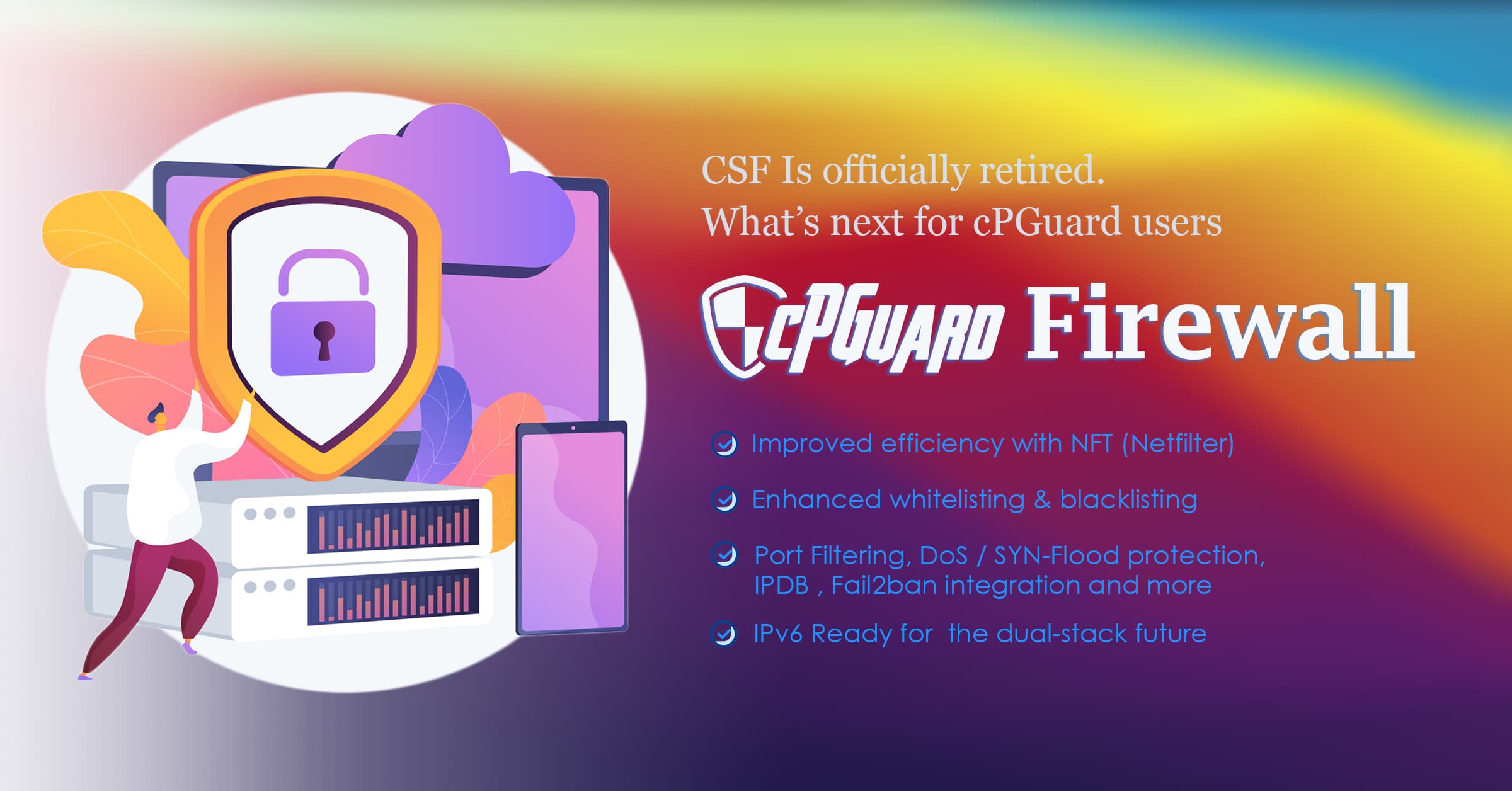
        <title>CSF Is Officially Retired. What’s Next for cPGuard Users?</title>
        <author>
            <name>Nibin V M</name>
        </author>
        <link href="https://www.opsshield.com/blog/csf-is-officially-retired-whats-next-for-cpguard-users/"/>
        <id>https://www.opsshield.com/blog/csf-is-officially-retired-whats-next-for-cpguard-users/</id>
        <media:content url="https://www.opsshield.com/blog/media/posts/43/cpguard-firewall.jpg" medium="image" />
            <category term="Uncategorized"/>

        <updated>2025-08-31T18:24:00+05:30</updated>
            <summary type="html">
                <![CDATA[
                        <img src="https://www.opsshield.com/blog/media/posts/43/cpguard-firewall.jpg" alt="" />
                    The End of an Era: CSF Is Officially Retired. What’s Next for cPGuard Users? For nearly two decades, ConfigServer Security &amp; Firewall (CSF) has been an indispensable tool for Linux administrators—a trusted first line of defence against malicious IPs. Its deep integration with cPanel/WHM, combined&hellip;
                ]]>
            </summary>
        <content type="html">
            <![CDATA[
                    <p><img src="https://www.opsshield.com/blog/media/posts/43/cpguard-firewall.jpg" class="type:primaryImage" alt="" /></p>
                
<h1>The End of an Era: CSF Is Officially Retired. What’s Next for cPGuard Users?</h1>
<p>For nearly two decades, <strong>ConfigServer Security &amp; Firewall (CSF)</strong> has been an indispensable tool for Linux administrators—<strong>a trusted first line of defence</strong> against malicious IPs. Its deep integration with <strong>cPanel/WHM</strong>, combined with a wide range of features, made it the <strong>default choice for sysadmins</strong>, especially in web hosting environments.</p>
<p>But times are changing. With the original developers announcing the <strong>end of CSF’s active development</strong> and releasing the code under <strong>GPLv3</strong>, its future now depends entirely on <strong>community contributions—an uncertain development path ahead</strong>. While this means CSF will continue in some form, for many administrators this marks the <strong>end of the CSF era</strong>—and raises an important question: what comes next?</p>

<h2>cPGuard’s Journey Beyond CSF and the Next Step</h2>
<p>At cPGuard, we have always recognised the importance of CSF. For years, we recommended <strong>CSF/LFD as the go-to Intrusion Prevention System (IPS) and Intrusion Detection System (IDS)</strong> to complement our own security solutions.</p>
<p>In recent years—<strong>to reduce complexity, improve performance, and eliminate dependence</strong>—we have quietly and diligently been evolving our own platform. For some time now, <strong>cPGuard has not depended on CSF.</strong></p>
<p>Core modules such as IPDB (abuse IP database), Bruteforce &amp; Bot Blocking, Fail2Ban integration, and other features that require IP blocking have long been <strong>fully managed within cPGuard itself using iptables/ipset</strong>.</p>
<p>The retirement of CSF simply confirms what we had already anticipated: <strong>it’s time to take the next step</strong>.</p>

<h2>A Fully Managed cPGuard Firewall</h2>
<p>We are <strong>revamping the entire firewall module from scratch</strong>, moving away from the legacy <strong>iptables/ipset</strong> approach and adopting the modern <strong>NFT (Netfilter)</strong> framework. This transition is not just a technical change—it enables us to deliver a firewall that is more powerful, efficient, and future-ready for our users.</p>
<p>The new cPGuard Firewall introduces:</p>
<ul>
<li><strong>Improved Efficiency</strong> – streamlined packet filtering with micro-loading, reducing overhead and improving performance under heavy traffic.</li>
<li><strong>Structured Management</strong> – cleaner, more organised rules and sets, making administration and troubleshooting far simpler.</li>
<li><strong>Enhanced Whitelisting &amp; Blacklisting</strong> – redesigned for speed and accuracy, ensuring legitimate traffic is preserved while malicious IPs are blocked instantly.</li>
<li><strong>IPv6 Ready</strong> – the new system is fully IPv6 capable, with port filtering already supporting IPv6. Full IPDB IPv6 support will arrive very soon, ensuring your servers are protected in the dual-stack future.</li>
<li><strong>Simplified Administration</strong> – consistent CLI and UI commands (cpgcli fw …), giving you a reliable, straightforward way to manage your firewall.</li>
</ul>

<h2>What’s Coming in the First Release?</h2>
<p>The initial rollout will deliver the <strong>core features you expect in a firewall</strong>:</p>
<ul>
<li><strong>Whitelist &amp; Blacklist (IP &amp; Country)</strong> – define trusted and blocked networks with precision.</li>
<li><strong>Extended Whitelist &amp; Blacklist Sources</strong> – import from file paths or remote URLs for efficient global management.</li>
<li><strong>Temporary Blocks (with expiry)</strong> – automatically remove bans after a set duration.</li>
<li><strong>Port Filtering</strong> – control inbound and outbound TCP/UDP traffic to close unwanted services.</li>
<li><strong>DoS / SYN-Flood Protection</strong> – safeguard servers against denial-of-service attacks.</li>
<li><strong>IPDB Integration</strong> – leverage a real-time global abuse IP database for proactive blocking.</li>
<li><strong>AI Bot Protection</strong> – block aggressive AI scraping bots.</li>
<li><strong>Fail2Ban Integration</strong> – service-level brute-force defence, serving as a modern replacement for CSF’s LFD.</li>
</ul>
<h2>When Can You Get It?</h2>
<p>The new firewall is already in <strong>staging</strong> and scheduled for public release in <strong>early September 2025</strong>. We are currently testing across a wide range of server environments and configurations, and refining safeguards to ensure smooth continuity.</p>
<p>Delivery will happen automatically through the cPGuard auto-update system, and the transition should be seamless and uneventful. In the rare event of conflict with third-party firewalls, package dependencies or issues, our support team will be ready to assist immediately.</p>
<p>Comprehensive documentation will be provided alongside the release.</p>
<h2>The Road Ahead</h2>
<p>This is not just about replacing CSF—it’s about <strong>future-proofing your servers</strong> with a firewall that integrates seamlessly with the <strong>cPGuard ecosystem</strong>. We are committed to making this a <strong>community-driven development</strong>, and we'll be listening closely to what you need.<br/><strong></strong></p>
<p><strong>Stay tuned for the official release announcement. The next chapter of server security starts now—with you. 🚀</strong></p>

            ]]>
        </content>
    </entry>
    <entry>
        <title>Database Scanning with cPGuard</title>
        <author>
            <name>Radhika Valsan</name>
        </author>
        <link href="https://www.opsshield.com/blog/database-scanning-with-cpguard/"/>
        <id>https://www.opsshield.com/blog/database-scanning-with-cpguard/</id>
        <media:content url="https://www.opsshield.com/blog/media/posts/42/database-scanner.jpg" medium="image" />
            <category term="Uncategorized"/>

        <updated>2025-05-05T19:58:23+05:30</updated>
            <summary type="html">
                <![CDATA[
                        <img src="https://www.opsshield.com/blog/media/posts/42/database-scanner.jpg" alt="" />
                    Website infections are no longer limited to just files — increasingly, attackers are targeting databases as well. Once a vulnerability is discovered, malicious actors can inject harmful code directly into the database. This can result in Redirection of visitors to compromised websites, Injection of JavaScript into the&hellip;
                ]]>
            </summary>
        <content type="html">
            <![CDATA[
                    <p><img src="https://www.opsshield.com/blog/media/posts/42/database-scanner.jpg" class="type:primaryImage" alt="" /></p>
                
<p>Website infections are no longer limited to just files — increasingly, attackers are targeting databases as well. Once a vulnerability is discovered, malicious actors can inject harmful code directly into the database. This can result in Redirection of visitors to compromised websites, Injection of JavaScript into the visitor's browser and various other malicious activities</p>
<p>These types of infections are especially dangerous as they can compromise site functionality, user trust, and reputation, and may lead to your website being blacklisted by antivirus and security solutions.</p>
<h2>Introducing the WordPress Database Scanner</h2>
<p>At cPGuard, we've observed that WordPress websites are most commonly affected by database-based code injections. To address this, we've introduced a new Database Scanner module as part of our security suite.</p>
<p>This module is carefully designed to:</p>
<ul>
<li>Minimize resource usage</li>
<li>Avoid false positives</li>
<li>Continuously improve through pattern-based detection</li>
<li>Auto-update its threat detection patterns</li>
</ul>
<h2>How the Database Scanner Works</h2>
<p>The database scanner functions as an extension to our CMS Scanner and Threat Finder. It is triggered under the following scenarios:</p>
<h3>1. Manual Scan</h3>
<p>When a manual scan is initiated, cPGuard automatically checks if the scan path contains a valid WordPress installation. If found, the database scan is run automatically and appended to the full scan report. The result is also available at Virus Scanner → DB Scanner</p>
<h3>2. Scheduled Scanning</h3>
<p>We run daily CMS discovery and analysis across your server. You can enable automatic database scans by toggling the feature under:<br/>App Portal → Server → Settings → Virus Scanner → Database Scanner</p>
<p>Once enabled, the database will be scanned daily, and the results will appear under:<br/>Virus Scanner → DB Scanner</p>
<h3>3. Command-Line Interface (CLI)</h3>
<p>You can run a database scan directly via the command line using the cpgcli utility.</p>
<h4>Scan a specific WordPress installation:</h4><pre class="language-bash"><code>cpgcli dbscan --scan /path/to/wp-installation</code></pre><h4>Scan all WordPress databases on the server:</h4><pre class="language-bash"><code>cpgcli dbscan --scan --all</code></pre><h4>For full usage instructions:</h4><pre class="language-bash"><code>cpgcli dbscan --help</code></pre>
<blockquote>
<p>Note: CLI-based scans display results directly in the console and do not store logs.</p>
</blockquote>
<h2>Roadmap &amp; Future Enhancements</h2>
<p>This database scanner is built on a robust foundation that allows for continued improvements. While the current version supports WordPress, We are actively working on adding more signature, Improving performance and extending support to other CMS platforms in future releases.</p>
<p>Stay tuned for updates, and as always, your feedback is welcome as we strive to make cPGuard the most comprehensive and efficient security solution for your web hosting environment.</p>

            ]]>
        </content>
    </entry>
</feed>